20 Years of Dolphin Research Reveals Critical Habitat in Byron Bay
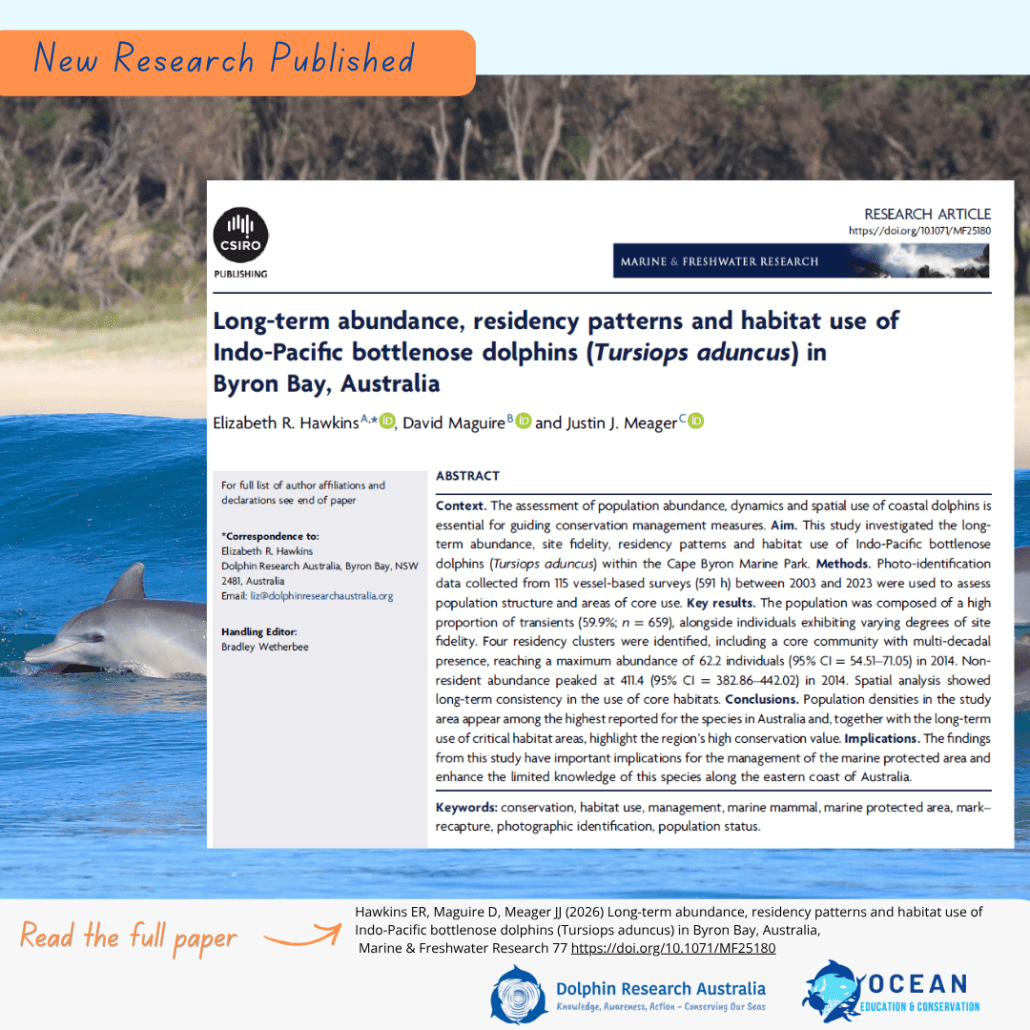
We are excited to share the publication of our latest scientific paper in Marine and Freshwater Research:
Long-term abundance, residency patterns and habitat use of Indo-Pacific bottlenose dolphins (Tursiops aduncus) in Byron Bay, Australia
This study represents more than 20 years of research and provides one of the longest-running photo-identification studies of Indo-Pacific bottlenose dolphins in Australia. It is also the first study in New South Wales to investigate long-term residency patterns and habitat use of dolphins inhabiting both exposed surf coast and semi-sheltered bay environments.
Understanding a Dynamic Dolphin Population
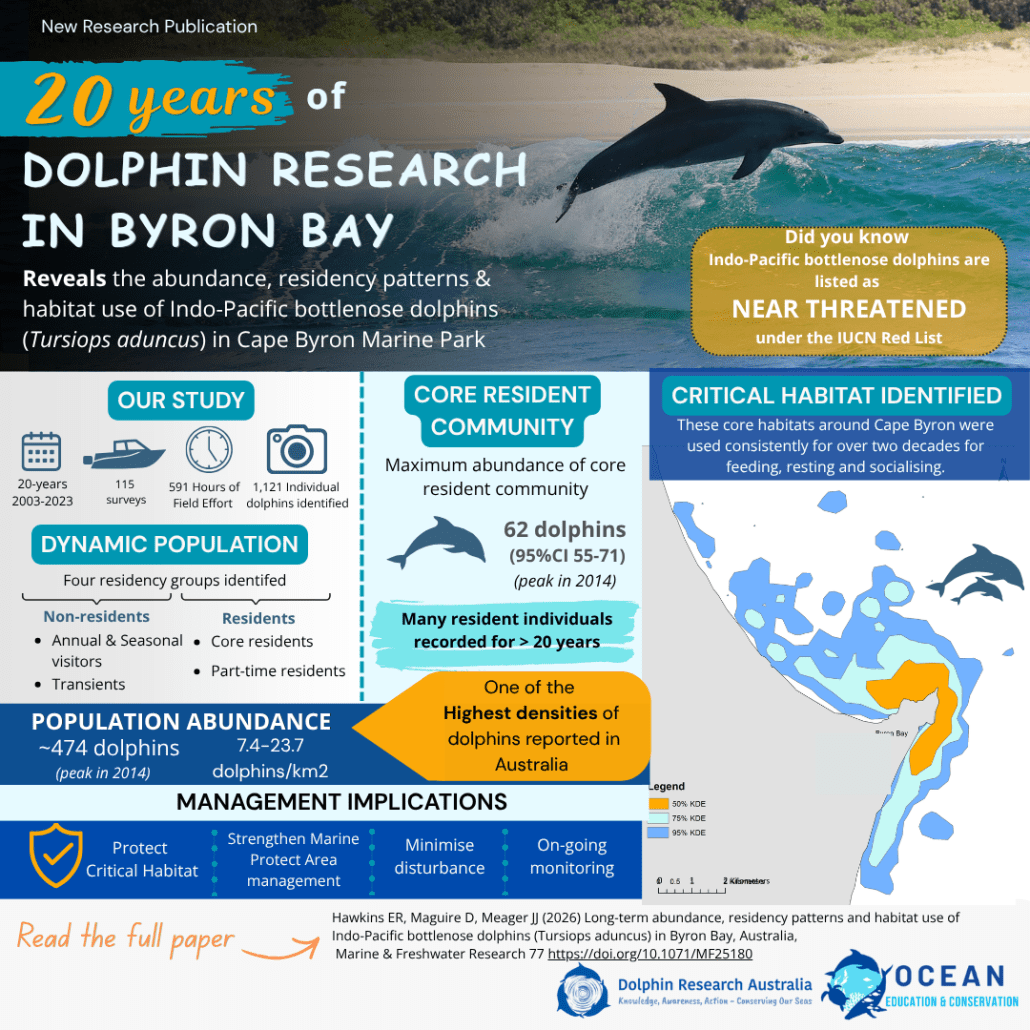
Between 2003 and 2023, our team completed 115 vessel-based surveys and collected more than 591 hours of field observations within Cape Byron Marine Park.
Using photo-identification techniques, we identified 1,121 individual dolphins and examined long-term patterns of abundance, residency and habitat use.
The study revealed a highly dynamic population structure. While many dolphins were transient visitors moving through the region, four distinct residency groups were identified, ranging from long-term residents to occasional visitors.
Importantly, a small core resident community of approximately 62 dolphins was identified. Some of these individuals have been documented within the region for more than 20 years, demonstrating remarkable long-term site fidelity and dependence on local habitats.
Critical Habitat Identified
One of the most significant findings of the study was the identification of a persistent core habitat area adjacent to Cape Byron.
Over two decades, dolphins consistently used this area for essential behaviours including feeding, resting, and socialising. The long-term persistence of these patterns highlights the ecological importance of this habitat and its role in supporting both resident dolphins and the broader regional population.
The study also found that dolphin densities within the study area were among the highest reported for this species in Australia.
Why This Research Matters
Long-term studies are essential for understanding how wildlife populations use habitats, respond to environmental change and interact with human activities.
Byron Bay is one of Australia’s most popular marine tourism destinations, and Cape Byron Marine Park supports a wide range of recreational, tourism and conservation values. Understanding where dolphins occur, how they use habitats and which areas are most important for their survival is critical for effective management.
Our findings demonstrate that Cape Byron Marine Park provides important habitat for both a resident dolphin community and a much larger population of visiting dolphins moving throughout the wider region.
Implications for Conservation and Management
The research highlights the importance of protecting critical habitat areas that support essential behaviours and long-term population persistence.
Incorporating these critical habitats into marine park planning and management will help ensure that conservation measures are targeted where they are most needed. Protecting these areas will not only benefit dolphins but also contribute to the broader health and resilience of marine ecosystems within the park.
As pressures on coastal environments continue to increase, long-term monitoring programs such as this provide an essential foundation for evidence-based conservation and adaptive management.
Acknowledgements
This research was partially supported by the NSW Department of Primary Industries and Regional Development through the Marine Estate Management Strategy Initiative 4.
We also extend our sincere thanks to the many volunteers, researchers, students, citizen scientists, supporters, donors and partners who have contributed to this project over the past two decades. Long-term conservation research is only possible through the dedication and commitment of a passionate community, and this publication is a reflection of those collective efforts.
Citation
Hawkins, E.R., Maguire, D. & Meager, J.J. (2026). Long-term abundance, residency patterns and habitat use of Indo-Pacific bottlenose dolphins (Tursiops aduncus) in Byron Bay, Australia. Marine and Freshwater Research. https://doi.org/10.1071/MF25180