
NSW Dolphin Census 2026: Hundreds of Citizen Scientists Help Reveal a Snapshot of Our Coastal Dolphins
More than 400 people joined forces across New South Wales for the inaugural NSW Dolphin Census, contributing hundreds of hours of observations and helping build a foundation for long-term monitoring of our coastal dolphins.
How well do we really know the dolphins living along the NSW coastline?
Despite decades of research in some locations, large sections of our coast remain poorly studied, with important knowledge gaps about dolphin distribution, occurrence, habitat use and population status.
To help address these gaps, Dolphin Research Australia partnered with NSW National Parks & Wildlife Service to deliver the first coordinated statewide citizen science Dolphin Census.
Conducted between 30 May and 7 June 2026, the Census brought together community members, school students, Aboriginal Land and Sea Rangers, experienced Dolphin Watch volunteers, researchers and marine tourism operators to undertake coordinated surveys along the NSW coast.
An incredible statewide citizen science effort
The response from communities across NSW was fantastic!
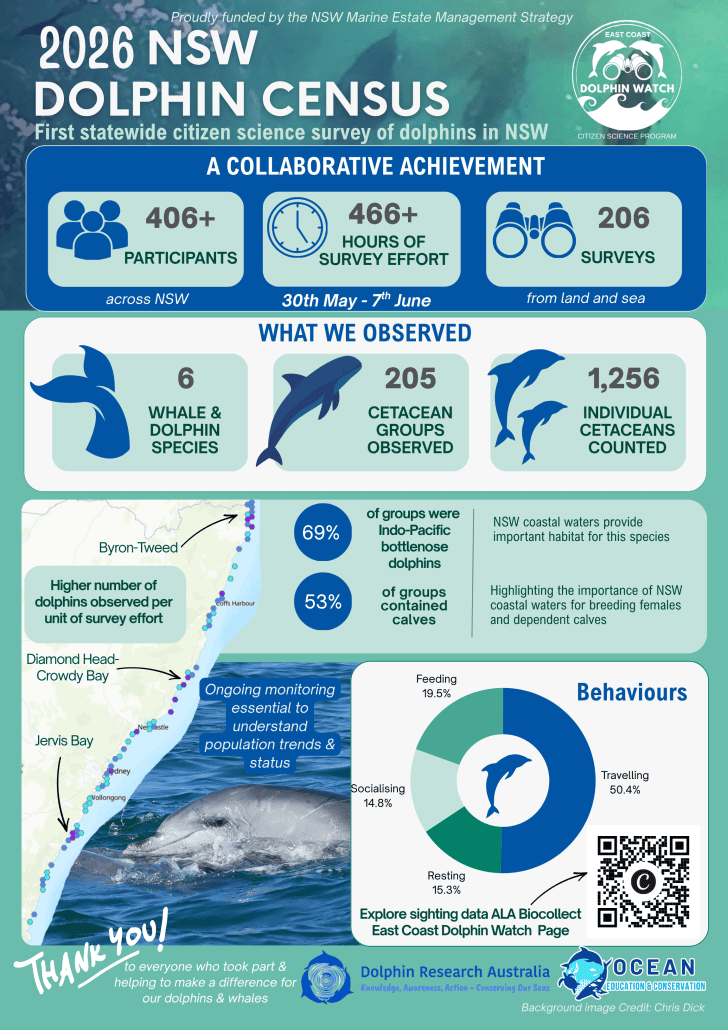
More than 400 people contributed to the Census, completing 206 dedicated surveys and approximately 466 hours of observation effort.
Participants searched for dolphins and whales from coastal lookouts, beaches, estuaries and vessels, recording not only the animals they encountered but also the time spent searching and the environmental conditions.
Importantly, surveys where no dolphins were observed were just as valuable, helping researchers understand survey coverage and interpret patterns of dolphin occurrence.
More than 350 people also participated in citizen science training, building their skills in dolphin and whale identification, behavioural observations and standardised survey techniques.
What did we discover?
Across the Census, participants recorded:
- 1,256 individual dolphins and whales
- 205 cetacean groups
- Seven species reported
- Almost 70% of groups were Indo-Pacific bottlenose dolphins
- More than half of recorded groups contained calves
Indo-Pacific bottlenose dolphins were the most frequently encountered species, consistent with their widespread distribution throughout NSW coastal waters, bays and estuaries.
Other species reported included common bottlenose dolphins, short-beaked common dolphins, false killer whales, humpback whales and minke whales.
The widespread observations of mothers and calves were particularly encouraging, providing valuable information about the use of NSW coastal waters by breeding females and dependent young.
Exploring where dolphins occur
One of the most valuable outcomes of the Census was the opportunity to examine dolphin observations across a broad geographic area using standardised survey methods.
While dolphins were recorded across much of the surveyed coastline, their occurrence varied considerably between locations.
Relatively higher encounter rates were recorded in parts of the far north coast, Crowdy Head–Diamond Head and Jervis Bay. Other areas, including Forster, Terrigal Haven and parts of the Sydney coastline, also contributed notable observations.
Some of these regions have been the focus of dedicated dolphin research over many years, while others have received relatively little scientific attention.
The Census has therefore helped highlight locations where further research and monitoring could improve our understanding of dolphin populations.
Participants also recorded important behaviours, including feeding, socialising, travelling and resting, providing additional insights into how dolphins may be using different coastal environments.
As the Census represents a snapshot during a relatively short period, the findings do not provide estimates of dolphin abundance or establish permanent habitat-use patterns. However, they provide valuable baseline observations that can be built upon through future surveys.
Why monitoring matters
Our coastal dolphins face a growing range of pressures, including pollution, habitat degradation, fisheries interactions, vessel disturbance and climate change.
Understanding how these pressures may affect dolphin populations requires reliable information collected consistently over time.
This is particularly important for Indo-Pacific bottlenose dolphins, which are now globally listed as Near Threatened on the IUCN Red List.
The inaugural Census represents an important first step towards improving our statewide understanding of these animals and the coastal environments they depend upon.
The Census is just the beginning!
Beyond the scientific findings, one of the greatest achievements of the project has been bringing together a growing network of people who are now equipped to help monitor dolphins along the NSW coastline.
Through our East Coast Dolphin Watch Citizen Science Program, everyone can continue contributing to long-term monitoring by undertaking regular surveys or reporting dolphin and whale sightings throughout the year.
The information collected will help build a stronger understanding of where dolphins occur, how they use coastal habitats and how these patterns may change over time.
Every observation counts — and together, we can make a difference for our dolphins!
Explore the Census findings
We’ve brought the results of the inaugural NSW Dolphin Census together in an interactive ArcGIS StoryMap, where you can explore the statewide findings, maps, photographs and stories behind this incredible community effort.
🗺️ EXPLORE THE NSW DOLPHIN CENSUS 2026 STORYMAP
You can also get involved in ongoing dolphin monitoring through our East Coast Dolphin Watch Citizen Science Program.
A huge thank you to every citizen scientist, volunteer, school, Aboriginal Land and Sea Ranger, research team, tourism operator and community organisation who contributed to the Census.
The NSW Dolphin Census was delivered by Dolphin Research Australia in partnership with NSW National Parks & Wildlife Service, with support from the NSW Marine Estate.
Together, we’re building knowledge, awareness and action to help conserve our dolphins and their coastal habitats.
